
Central America
Panamanian university community demands repeal of mining contract
November 23 |
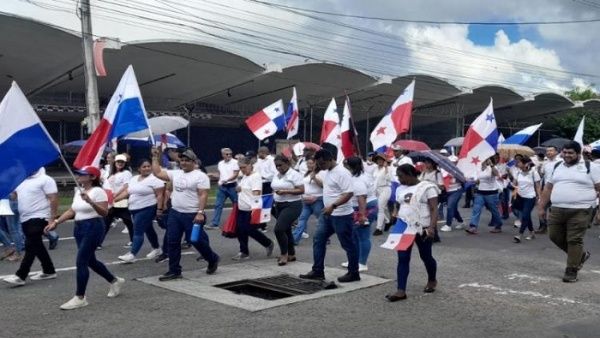
Professors, students, and administrative staff of the University of Panama marched this Wednesday to the Supreme Court of Justice of that country to demand the ruling of unconstitutionality of Law 406.
The rector of the university, Eduardo Flores, said that the protesters also intend to deliver an open letter, addressed to the authorities, in which they argue why the contract with Minera Panama, a branch of the Canadian company First Quantum Minerals, is unconstitutional.
The document states that “the legislative procedure followed for the approval of this contract-law violates the constitutional norms” since it can only be “approved or rejected”, “there is no power to return it in order to make modifications to its content, as it happened”.
The letter denounced that “the contract, contained in law 406, violates the constitutional norms on the ecological regime which oblige the State to guarantee that the population lives in a healthy environment free of contamination”, in reference to the fact that the area granted for this mining exploitation is within the Mesoamerican Biological Corridor.











The text argued that this is the largest open-pit copper mine in Central America, as well as that it “violates the human right of Panamanians to live in a healthy environment and implies the abandonment of the Panamanian State of the protection, preservation and improvement of that environment”.
Finally, the document urged the Supreme Court to “pronounce in a timely manner and in law, but also in accordance with the arguments made by the great majority of the Panamanian people in favor of the unconstitutionality and inconvenience of the referred mining contract”.










Central America
El Salvador and Chile Mark 150 Years of Relations With Expanded Bilateral Cooperation
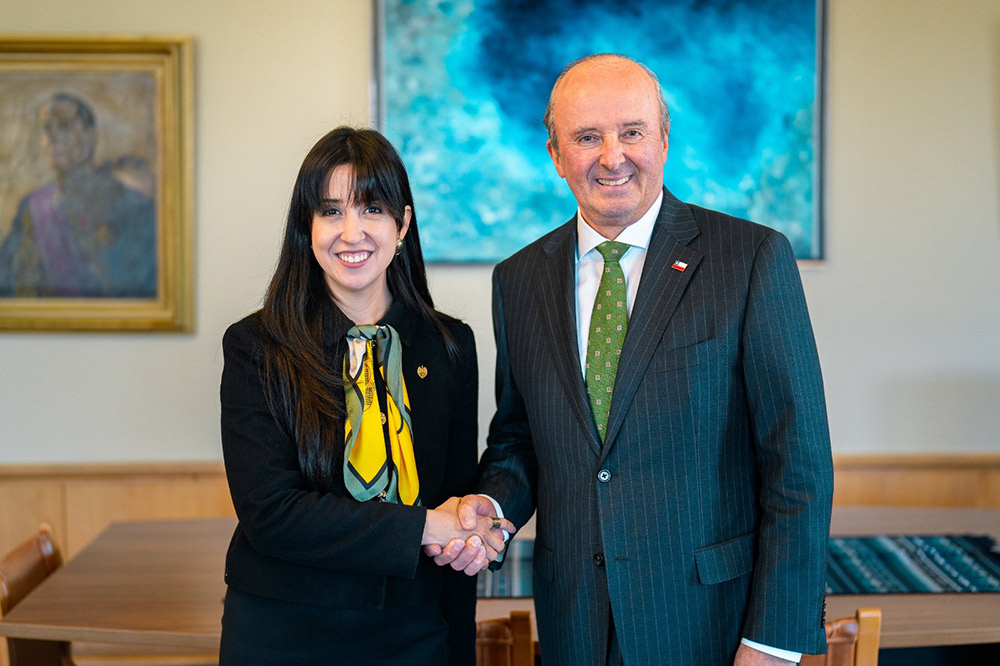
El Salvador and Chile are strengthening their diplomatic and cooperation ties through the official visit of Salvadoran Deputy Foreign Minister Adriana Mira to the South American country.
The purpose of the visit is to expand economic exchanges, promote new cooperation opportunities, and strengthen the bonds of friendship between both nations, according to El Salvador’s Foreign Ministry.
During her visit, Mira held a meeting with her Chilean counterpart, Patricio Torres, where they discussed issues of common interest and actions aimed at further advancing bilateral relations.
The agenda included initiatives to promote trade, encourage investment in strategic sectors, and strengthen joint efforts in different areas of cooperation.
As part of this process, both countries are preparing the 5th Meeting of the Joint Commission for Technical and Scientific Cooperation, where they are expected to establish a new framework for bilateral collaboration aimed at creating mutual benefits.
The meeting also carried a historic significance, as El Salvador and Chile are commemorating 150 years of diplomatic relations in 2026.
Representatives from both governments highlighted the importance of continuing to deepen their ties of friendship and cooperation to support shared development goals.
El Salvador’s Foreign Ministry emphasized that the relationship between both countries seeks to advance greater economic, commercial, and technical integration while taking advantage of new opportunities for collaboration.
International
Cristiano Ronaldo Makes History as First Player to Score in Six World Cups

Cristiano Ronaldo made football history on Tuesday by becoming the first player ever to score in six different editions of the FIFA World Cup.
The Portuguese forward opened the scoring in Portugal’s Group K match against Uzbekistan in Houston. Just six minutes into the game, Ronaldo found the back of the net with a right-footed strike from inside the box, sending the Portuguese fans into celebration.
The “Commander” sparked excitement throughout the stadium with his iconic celebration, as supporters joined in with his famous “Siuuu!” chant to honor another milestone in the career of one of football’s greatest stars.
At 41 years old, Ronaldo has now scored in Germany 2006, South Africa 2010, Brazil 2014, Russia 2018, Qatar 2022, and North America 2026. With his two goals in this tournament, he has surpassed Lionel Messi’s record, as the Argentine has scored in every World Cup he played except South Africa 2010.
The Portuguese captain has also reached nine World Cup goals, matching Eusébio as Portugal’s all-time top scorer in the history of the tournament.
Ronaldo’s achievement came just one day after Messi also made history by becoming the outright leading scorer in World Cup history, reaching 18 goals after scoring twice in Argentina’s 2-0 victory over Austria.
With his appearance at the 2026 World Cup, Cristiano Ronaldo has also extended another remarkable record by becoming the first player to participate in six consecutive editions of the tournament, further cementing his legacy as one of the most influential players in football history.
Central America
Costa Rica Launches Largest Police Operation in History, Dismantles Major Drug Cartel
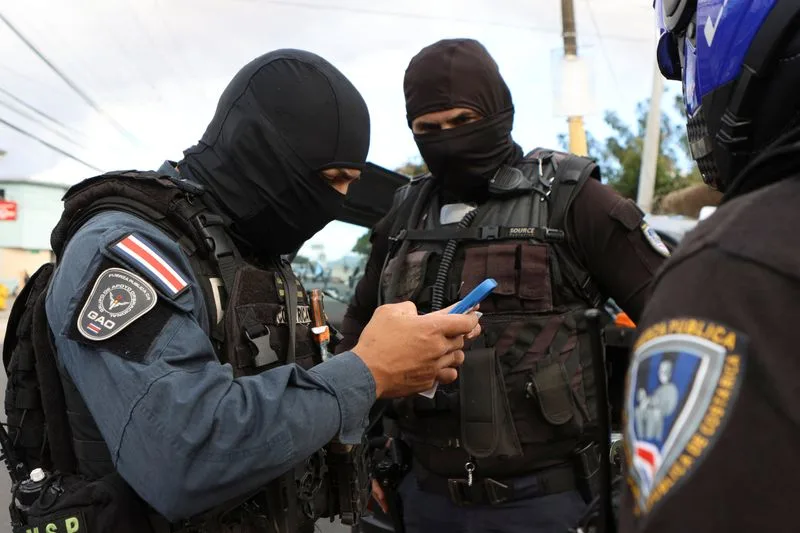
Costa Rican judicial authorities on Tuesday announced the largest police operation in the country’s history, resulting in the dismantling of a major local drug trafficking organization allegedly led by a man who was extradited to the United States earlier this year.
More than 1,500 law enforcement officers carried out 97 raids across different regions of the country, targeting 41 suspects and seizing assets valued at nearly $22 million, according to Michael Soto, director of the Judicial Investigation Agency (OIJ).
Speaking in a video statement, Soto described the operation as unprecedented in scale and coordination.
“This is the largest operation we have ever conducted. Never before have we carried out so many raids with our officers working alongside prosecutors from the Public Ministry and security forces from the Executive Branch. It is historic,” Soto said.
The operation, dubbed “Riverside,” was the result of months of investigations conducted with support from the U.S. Drug Enforcement Administration (DEA).
Authorities said the large-scale crackdown dismantled one of the country’s most significant criminal organizations involved in international drug trafficking, a major contributor to the security crisis affecting the Central American nation, long known for its stability and tourism industry.
According to investigators, the operation focused on uncovering the multimillion-dollar business activities of a Costa Rican criminal network allied with a Colombian group known as “Los Costeños.”
The alleged leader of the organization was identified as Edwin Pérez, also known as “Pecho de Rata,” who was extradited to the United States on March 20 alongside former Security Minister and former Supreme Court magistrate Celso Gamboa.
Both men were arrested on June 23, 2025, shortly after a legislative reform came into effect allowing Costa Rican citizens suspected of drug trafficking to be extradited to foreign jurisdictions.
Among those detained during the operation were two prison officers, two former professional football players and a model. Prosecutors indicated that the suspects could face charges including domestic and international drug trafficking, arms trafficking, possession of explosives, smuggling drugs into correctional facilities, money laundering and participation in organized criminal activities.
Authorities stated that the investigation remains ongoing and that additional arrests and asset seizures could follow as prosecutors continue to examine the network’s operations and financial structure.

Three Die During World Cup Celebrations in Mexico City After Mexico’s Victory

Families Sue Nicolás Maduro in U.S. Over Alleged Extrajudicial Killings

Salvadoran National Arrested in New Jersey with Over 70 Machine Gun Conversion Devices
Tec de Monterrey honors one of its students for his contribution to nanotechnology in medicine

Defense Minister commends salvadoran soldier for Central American Cross Country victory

Extension of the state of emergency approved in southern Chile
-
 International3 days ago
Looting Spreads in Venezuela’s Hardest-Hit Areas After Deadly Earthquakes
-
 International1 day ago
Salvadoran National Arrested in New Jersey with Over 70 Machine Gun Conversion Devices
-
 International2 days ago
Venezuela Earthquake Death Toll Surpasses 1,700 as Search for Survivors Continues
-
 International2 days ago
Venezuela Earthquakes Spark Diplomatic Thaw With Former Critics
-
 International4 days ago
UN warns Venezuela earthquakes could affect up to 6.76 million people
-
 International4 hours ago
Families Sue Nicolás Maduro in U.S. Over Alleged Extrajudicial Killings
-
 International3 hours ago
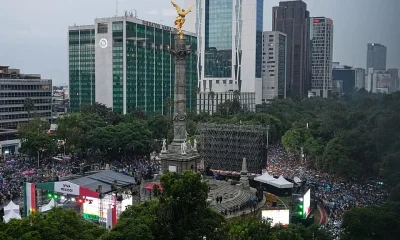
Three Die During World Cup Celebrations in Mexico City After Mexico’s Victory