
International
Possible lack of final agreement overspeaks Baku summit negotiations
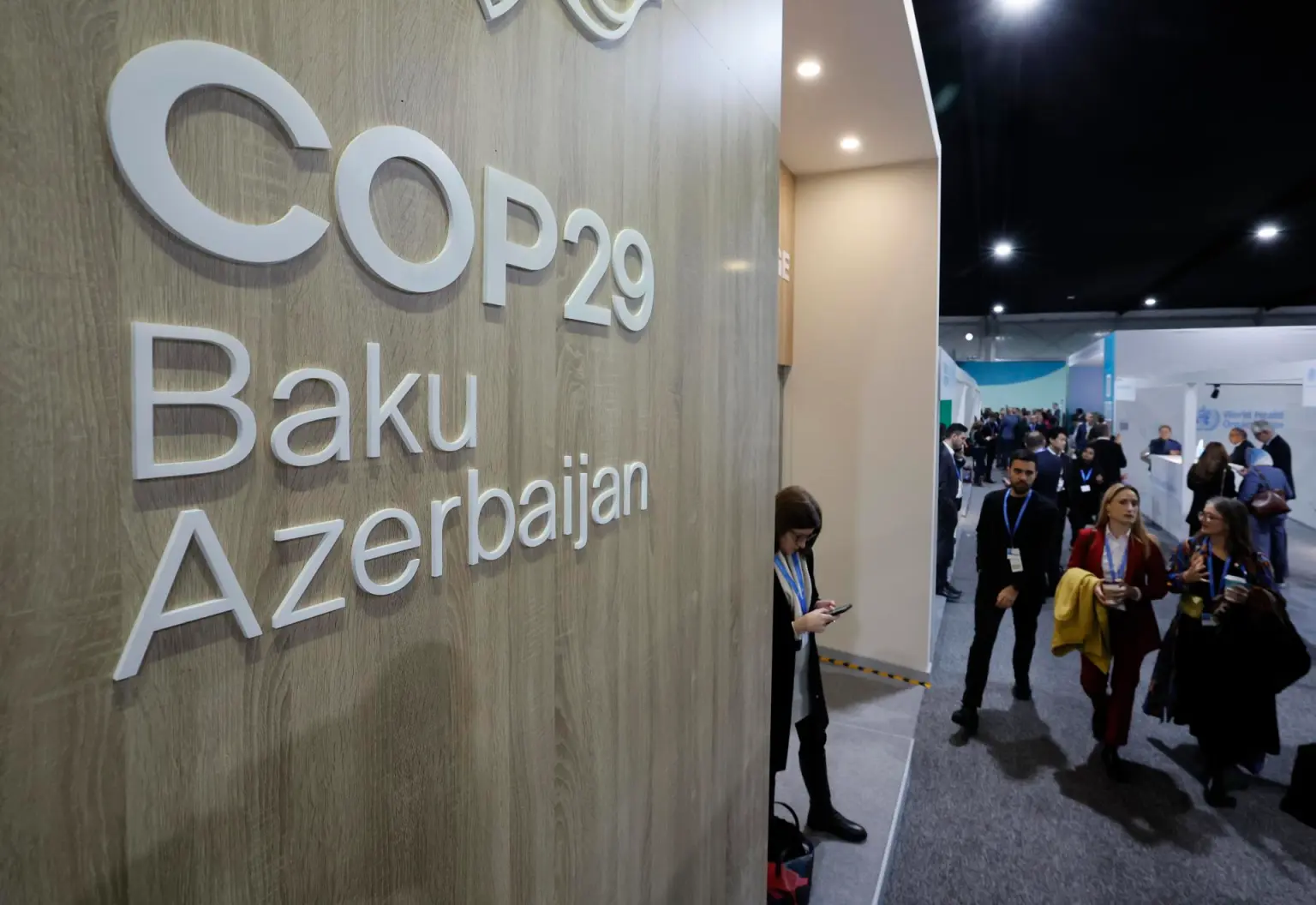
Baku can go down in history as another failed climate summit, adding to the list of COPs that ended in failure; with a bad agreement, as in Copenhagen (2009) or without agreement, as in the summit in The Hague (2000).
This is raised in the conversations that negotiators, observers and journalists have this Saturday in the corridors of COP29, after the 24 hours of extension of a summit that was supposed to end on Friday afternoon and in full “chaos” after dozens of countries left the room where the draft of the potential agreement was being negotiated.
The analysts and observers consulted, as well as the negotiating teams, agree to underline the “especially chaotic” end of this summit, from which a not too encouraging outcome is expected: either a “bad agreement” – that does not meet the needs of the Global South to face the climate challenge – or, directly, without agreement.
Pessimism invaded the spaces of the summit that hosts these days the capital of Azerbaijan, and in which about 200 states have been negotiating for two weeks how to finance climate action, especially in those low-income countries and vulnerable to the impacts of global warming.
Everyone mentions the ghost of the failed summits in The Hague and Copenhagen, cases that they would like to avoid, because they fear that going through another failure like this would further undermine the already weaken confidence in multilateralism.












Some developing countries leave the trading room
In addition, small island states and some Africans left the negotiation room where they met the presidency’s latest proposal for the agreement on climate financing that finalizes COP29, where they said they did not feel heard.
Political representatives of the negotiating group that brings together the least developed countries, as well as that of the small island states claimed to have come to the climate summit in Baku to close “a fair agreement” on climate financing, but they have felt “hurt” by not being consulted.
“There is an agreement to be closed and we are not being consulted. We are here to negotiate, but we are leaving because at the moment we do not feel that we are being heard,” said the head of the negotiating group of the island countries, Cedric Schuste, in statements to the media.
“We do everything we can to build bridges with literally everyone. It is not easy, neither in financing nor in mitigation,” stressed the European Commissioner for Climate Action, Wopke Hoekstra, to emphasize that “it is fair to ask that we be constructive.”
Some Latin American and Caribbean states, which are trying to build bridges between the least developed and rich countries, expressed their refusal to admit that this Baku summit is closed without an agreement.
“We cannot leave Baku or Copenhagen,” said Panama’s special climate envoy, Juan Carlos Monterrey, in reference to the climate summit held in the Danish capital in 2009, a meeting that the international climate community considered a failure, by not reaching any agreement.
“We are already at a point of not only building bridges, but walking on those bridges,” Monterrey said, after detailing that the countries had left the consultation mainly because of their discrepancies regarding the total amount that rich countries suggest mobilizing to pay for the climate transition and adaptation to the inevitable impacts of global warming.
“The great struggle is the figure,” said Monterrey, since developing countries at this point support that the goal is 300 billion dollars per year by 2035, and developing and emerging economies ask for 500 billion dollars annually and by 2030.
Lack of transparency in the process
Panama’s main negotiator, Ana Aguilar, also criticized the lack of transparency in the process, something she blamed on the Azerbaijani presidency of the summit, which according to her has had more meetings with some parties than with others, and has been three days without favoring negotiations more than bilaterally.
“We have a problem,” said Colombian Minister Susana Muhamad, who claimed that there is still a long distance between the amount that rich countries propose to mobilize and that requested by those that developing countries.
The proposal of the presidency of the COP29, as reflected in a negotiating text made public on Friday, was that the awealing countries pay 250 billion dollars a year by 2035 to the states of the Global South, to help them pay for action against climate change, a phenomenon to which they hardly contribute but of which they are the main victims.
Now there is talk of 300 billion dollars, while the largest group of developing countries demands at least 500 billion.
The dispute is especially in the quantum, Muhamad said, but also “in some of the requirements that I think we can achieve through negotiation,” he said.
“The problem is that it has been published very late, it was published yesterday. The deadline is very short, so we have some countries, those that have less financial capacity, that do not feel satisfied,” explained Muhamad, who added that “we need them to be able to move and deliberate.”
The Colombian minister said that she will encourage rich countries “to take a step forward” and, she added, “it is very important that they do so so that we can move forward and carry out this negotiation.”










International
Joe Biden’s Prostate Cancer Has Spread to His Bones, Son Hunter Reveals
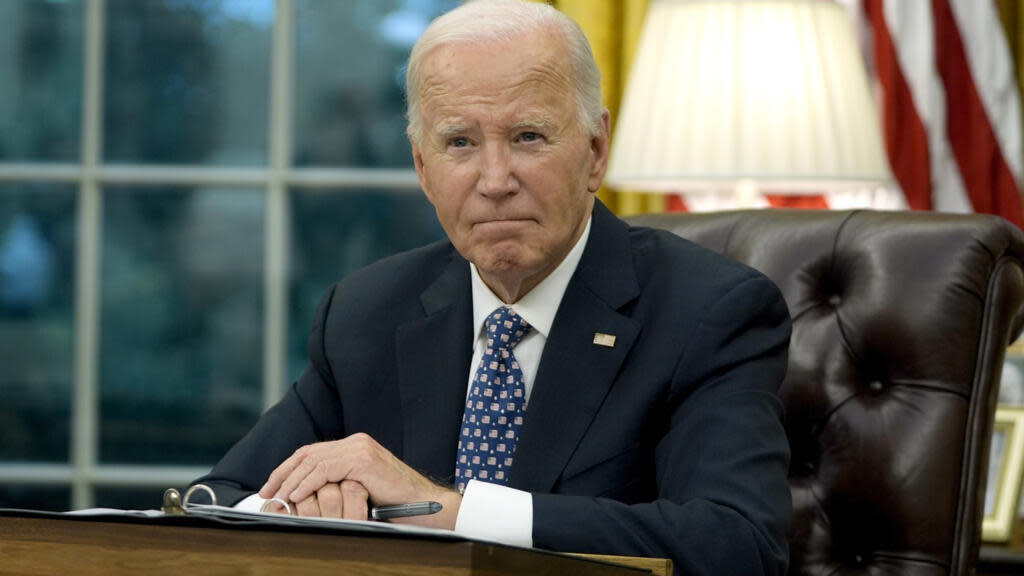
Former U.S. President Joe Biden’s prostate cancer has worsened and spread to his bones and other parts of his body, his son Hunter Biden revealed in a recent interview with the BBC.
Biden disclosed in May 2025, just four months after leaving office as the oldest sitting U.S. president in history, that he had been diagnosed with an aggressive form of prostate cancer that had already spread to his bones.
The former president subsequently began treatment, including radiation and hormone therapy. In July, while announcing the publication of his memoirs, Biden said the treatment was going “really well.”
However, in an extensive interview broadcast Friday night on the BBC’s Newsnight, Hunter Biden said his father’s condition had progressed despite treatment.
“The cancer has spread and metastasized to his bones and other places,” Hunter Biden said.
He added that the illness has been “very painful” and, in many ways, “very debilitating,” but said his father continues to remain active.
“He’s still out there. He’s still doing his thing,” Hunter Biden said, emphasizing that his father remains deeply committed to the United States.
The former president’s diagnosis has remained a subject of public attention since it was first announced, particularly because of his age and his decision to continue a public life after leaving the White House.
International
US announces $1 billion security assistance package for Colombia under new government
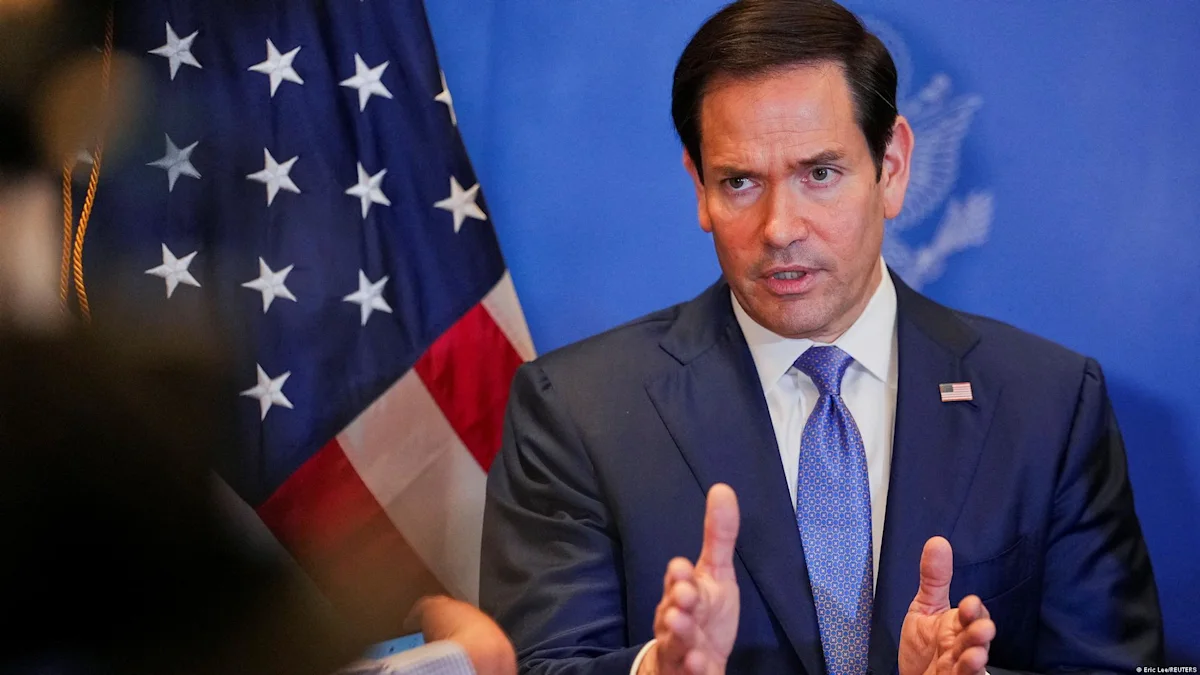
The U.S. Department of State announced Friday that Washington plans to provide Colombia with $1 billion as part of a security assistance package aimed at supporting the new government of far-right President Abelardo de la Espriella.
The administration of U.S. President Donald Trump said it intends to coordinate with Congress to announce the assistance package, which was unveiled on the occasion of De la Espriella’s inauguration. The United States attended the ceremony with a delegation led by acting Attorney General Todd Blanche.
The package is designed to strengthen Colombian security forces in their fight against terrorist organizations and transnational criminal groups through U.S. technology, increased operational capabilities and coordinated operations with American forces.
The assistance would also significantly expand coca crop eradication and cocaine interdiction operations, while strengthening efforts to track and disrupt the finances of criminal organizations.
Washington also offered to support Bogotá’s efforts to restore state control over territories dominated by armed groups, protect children from forced recruitment and curb irregular migration through greater coordination along the border.
The State Department described the measures as part of a new chapter in bilateral relations between the United States and Colombia. The broader framework also includes cooperation in areas such as energy, critical minerals, infrastructure, technology and civilian nuclear energy.
Relations between Washington and Bogotá had been strained during the administration of former President Gustavo Petro, particularly over migration and security policies.
De la Espriella’s arrival in office, accompanied by promises of a hard-line approach to armed groups and drug trafficking, is expected to mark a new stage in relations between Colombia and the United States.
International
Abelardo de la Espriella sworn in as Colombia’s president for 2026-2030
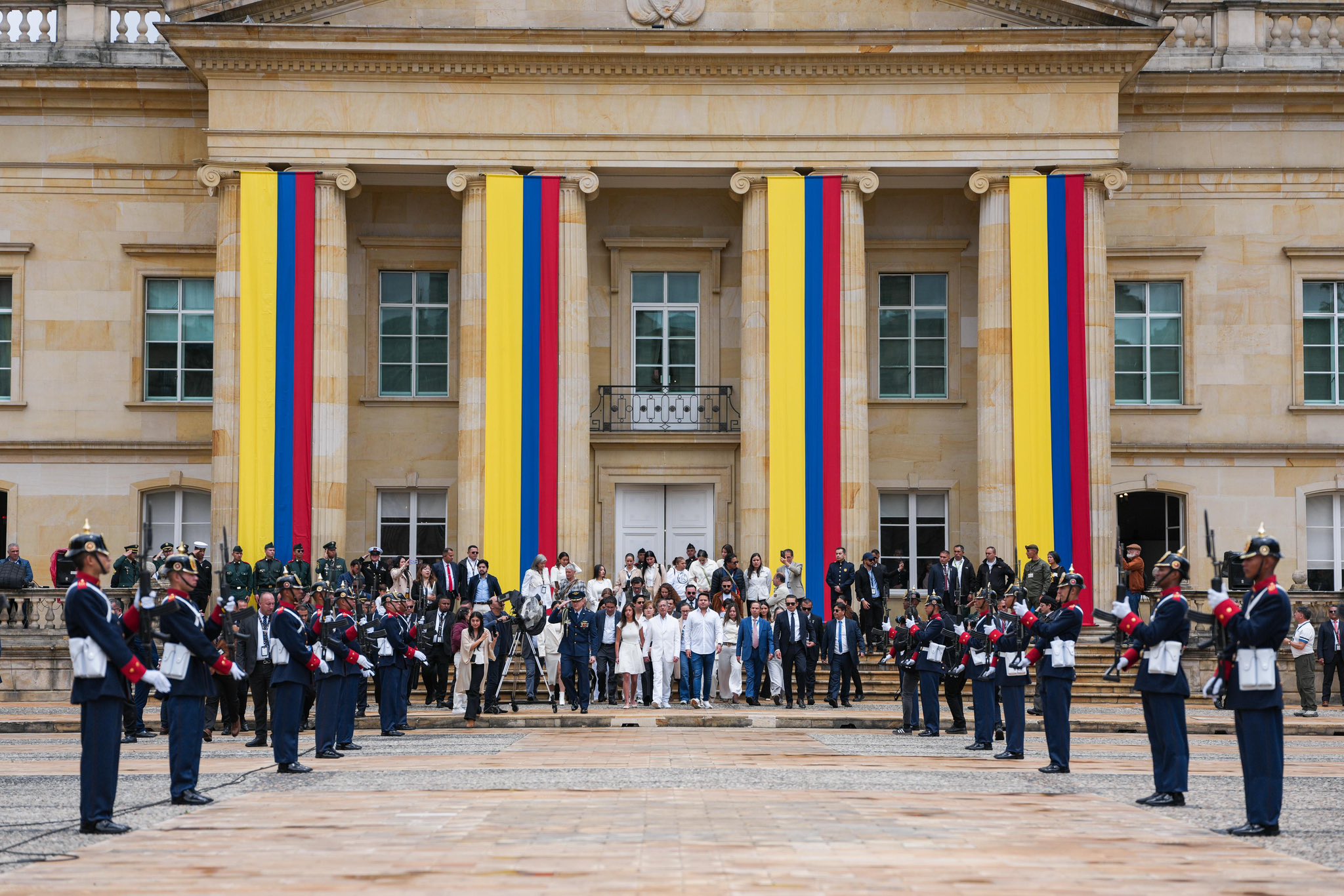
Lawyer Abelardo de la Espriella was sworn in Friday as Colombia’s president for the 2026-2030 term during an inauguration ceremony held at the USC Arena of the Santiago de Cali University in Valle del Cauca.
“I swear to God and promise the Colombian people to faithfully uphold the Constitution and the laws of Colombia,” De la Espriella, 48, said as he took the oath before Senate President Honorio Henríquez, who subsequently placed the presidential sash on him, formally marking the transfer of power from former President Gustavo Petro.
At the same time, members of the Colombian Army performed the traditional 21-gun salute from the José María Córdova Military Cadet School in Bogotá. After receiving the presidential sash, De la Espriella was applauded by those attending the ceremony and greeted by his family.
The new president later swore in Vice President José Manuel Restrepo. The ceremony also included the participation of 74-year-old farmer Luis Felipe Yagüé, whom De la Espriella invited as an honorary guest as a symbol of his support for small business owners and entrepreneurs.
De la Espriella arrived at the venue with his wife, Ana Lucía Pineda, and their four minor children. More than 1,000 national and international guests attended the ceremony, which began more than an hour later than scheduled.
Among the international figures present were King Felipe VI of Spain and presidents Javier Milei of Argentina, Daniel Noboa of Ecuador, Santiago Peña of Paraguay, José Raúl Mulino of Panama, Luis Abinader of the Dominican Republic, José Antonio Kast of Chile and Nasry Asfura of Honduras. FIFA President Gianni Infantino also attended.
Former Colombian presidents César Gaviria, Andrés Pastrana, Álvaro Uribe and Iván Duque were also present. Former President Ernesto Samper and Nobel Peace Prize laureate Juan Manuel Santos, however, were not invited to the ceremony.
After the inauguration ceremony concluded, De la Espriella traveled to the Pichincha Military Canton in Cali, where he was scheduled to deliver his first address as head of state to Colombia’s senior military commanders.

Joe Biden’s Prostate Cancer Has Spread to His Bones, Son Hunter Reveals

US announces $1 billion security assistance package for Colombia under new government

Abelardo de la Espriella sworn in as Colombia’s president for 2026-2030
Tec de Monterrey honors one of its students for his contribution to nanotechnology in medicine

Defense Minister commends salvadoran soldier for Central American Cross Country victory

Extension of the state of emergency approved in southern Chile
-
 International3 days ago
Abelardo de la Espriella sworn in as Colombia’s president for 2026-2030
-
 International3 days ago
Appeals Court blocks Trump’s White House ballroom project without congressional approval
-
 International3 days ago
Rubio warns Cuba U.S. pressure campaign will continue through Trump’s term
-

 International4 days ago
Afghan man sentenced to life in prison for deadly Munich vehicle attack
-
 International2 days ago
US announces $1 billion security assistance package for Colombia under new government
-
 International21 hours ago
Joe Biden’s Prostate Cancer Has Spread to His Bones, Son Hunter Reveals