
International
180 venezuelan migrants deported from U.S. return on repatriation flight
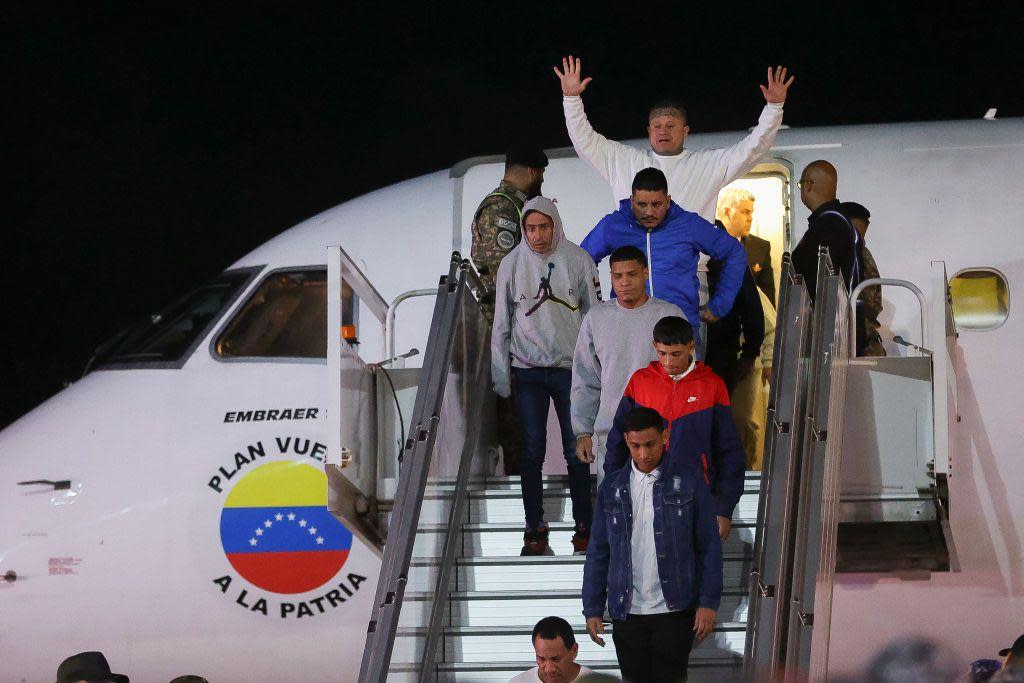
A total of 180 Venezuelan migrants deported from the United States returned to their home country on Friday aboard a U.S. aircraft, Venezuela’s Ministry of Interior and Justice reported.
The group, made up of 160 men, 16 women, and four children, arrived at Simón Bolívar International Airport in Maiquetía, near Caracas, on an Eastern Airlines flight, according to official images shared on Instagram. Upon arrival, the deportees were received by public security authorities and state institutions, including the Administrative Service for Identification, Migration and Foreigners (Saime). They also underwent medical evaluations to verify their health conditions.
This marks the 71st repatriation flight so far this year, with more than 12,000 Venezuelans having returned, according to figures released by the government of Nicolás Maduro. The deportations have been carried out under a bilateral agreement signed between Caracas and Washington in January, despite the two countries severing diplomatic ties in 2019.
The Venezuelan government stated that these flights are part of the “Great Homeland Return Mission”, a program aimed at facilitating the voluntary return of citizens while also receiving those deported from the United States.






International
MS-13 Member Sentenced to 35 Years for Fatal Subway Killing in New York

A federal court in New York has sentenced Salvadoran national Víctor López, known by the alias “Curioso” and identified as a member of the Mara Salvatrucha (MS-13) gang, to 35 years in prison for his role in the 2019 killing of Abel Mosso at a subway station in Queens.
The sentence was handed down by U.S. District Judge LaShann DeArcy Hall after López pleaded guilty in February 2025 to racketeering-related charges and causing the victim’s death through the use of a firearm. U.S. authorities also stated that López agreed to be deported to El Salvador upon completion of his prison sentence.
According to court records, the attack took place on February 3, 2019, when López and four other MS-13 members traveled to a New York City subway station with the intention of locating and killing Mosso, whom they believed to be affiliated with the rival Barrio 18 gang.
Investigators determined that López, along with Ramiro Gutiérrez and Tito Martínez-Alvarenga, followed the victim onto a Line 7 subway train. The group allegedly assaulted Mosso before forcibly dragging him onto the platform at the station located near 90th Street and Roosevelt Avenue in Jackson Heights, Queens.
During the confrontation, López reportedly drew a firearm. Prosecutors said Mosso briefly managed to wrestle the weapon away from him. As bystanders attempted to intervene, one of the gang members warned them not to interfere.









“Don’t get involved, we are MS-13, we’re going to kill him,” one of the attackers allegedly shouted in both Spanish and English, according to court documents.
The investigation found that Ramiro Gutiérrez later regained possession of the firearm and shot Mosso multiple times in the head, killing him at the scene.
Authorities also stated that after the attack, López burned the clothing he had worn during the assault in an effort to destroy evidence and avoid identification by law enforcement.
U.S. Attorney Joseph Nocella Jr. for the Eastern District of New York said the sentence reflects the severity of a brutal gang-related murder carried out in broad daylight at a crowded public transportation hub.
Federal prosecutors described the case as part of ongoing efforts to dismantle violent gang networks operating in New York and to hold those responsible for acts of organized criminal violence accountable.
International
U.S. Launches Military Strikes on Iran Following Apache Helicopter Incident

The United States launched military strikes against Iran on Tuesday in what officials described as an act of “self-defense” following the alleged downing of a U.S. Army AH-64 Apache helicopter near the strategically important Strait of Hormuz.
The operation was confirmed by the U.S. Central Command (CENTCOM), which stated that the attacks began at 5:00 p.m. Eastern Time under direct orders from President Donald Trump.
“U.S. Central Command (CENTCOM) forces began conducting self-defense strikes against Iran today at 5:00 p.m., following the Commander-in-Chief’s instructions, in response to yesterday’s downing of a U.S. Army Apache helicopter,” the military command said in a statement.
According to U.S. authorities, the helicopter was involved in operations near the Strait of Hormuz, one of the world’s most critical maritime routes for global oil shipments, when the incident occurred. Officials reported that the two service members on board were rescued alive approximately two hours later.
President Trump had earlier signaled that a military response was being considered, arguing that the incident amounted to a direct attack by Iranian forces amid rising tensions between Washington and Tehran.
CENTCOM described the military action as a proportional response to what it characterized as an unjustified act of aggression by Iran.
The escalation comes at a time of heightened instability across the Middle East, fueled by recent confrontations between Iran and Israel and the continued presence of U.S. military forces in the Persian Gulf to safeguard commercial shipping lanes and strategic operations.
Hours after the U.S. announcement, Iranian Foreign Minister Abbas Araqchi responded through social media, issuing a warning directed at foreign military forces operating near Iranian territory.
The latest developments have intensified concerns about the possibility of a broader regional conflict, as diplomatic and military tensions continue to rise across the Middle East.
Central America
Bukele Tops Latin America’s Presidential Approval Ranking in June, Survey Finds
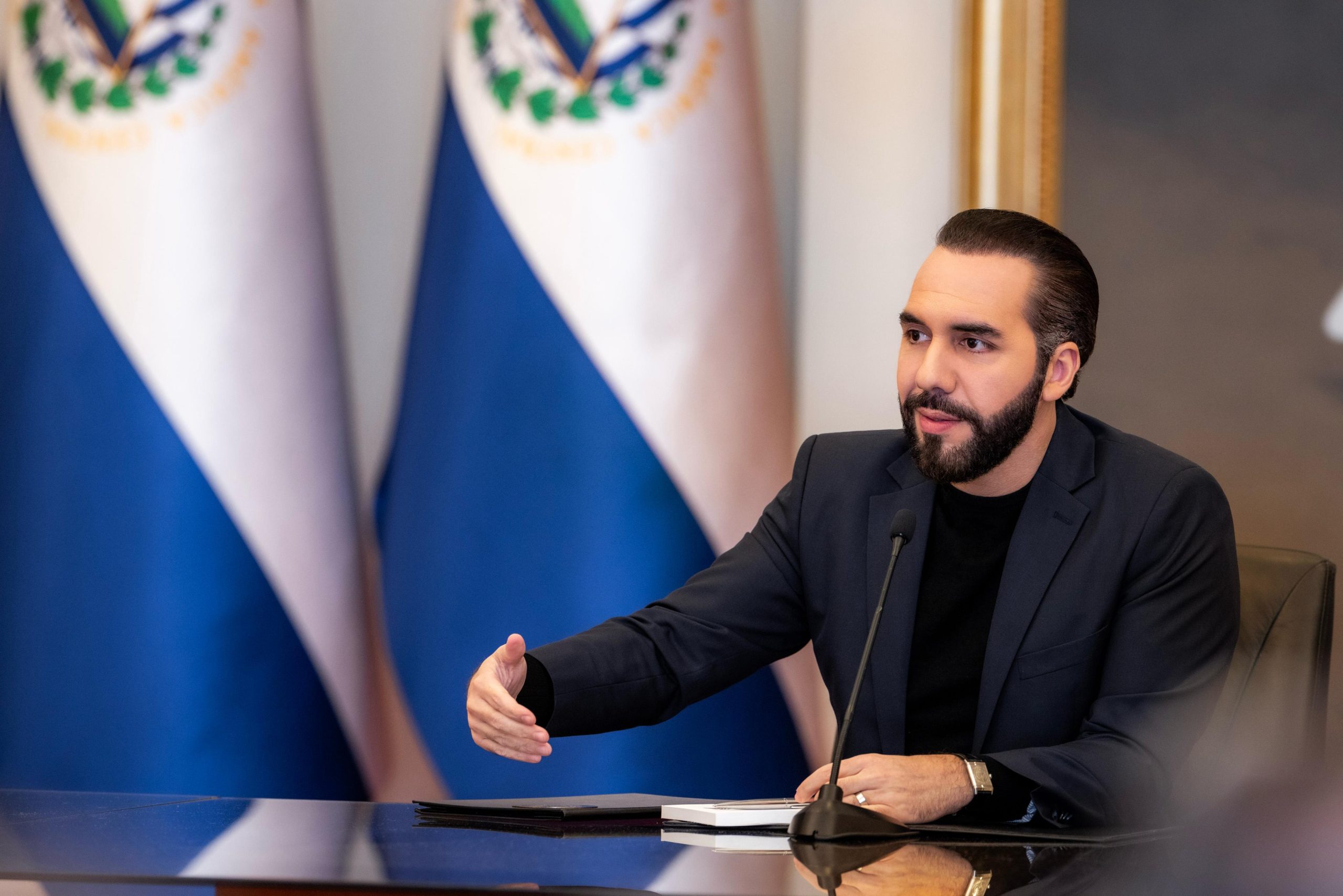
President Nayib Bukele of El Salvador, President Claudia Sheinbaum of Mexico, and President Laura Fernández of Costa Rica are the three highest-rated leaders in Latin America, according to the latest June 2026 presidential approval survey conducted by CB Global Data. The study places Peru’s interim president, José María Balcázar, at the bottom of the regional ranking.
Bukele leads the list with a 69.1% approval rating and a 27.6% disapproval rate, improving on the 67.5% positive image recorded in May. The Salvadoran president has maintained a state of emergency since March 2022 as the cornerstone of his anti-gang security strategy, a policy that continues to shape public perceptions of his administration.
Sheinbaum, Mexico’s first female president, ranks second with a 65.5% approval rating and 31% disapproval. Although she remains among the region’s most popular leaders, her support declined from the 67.8% approval registered in May.
Completing the top three is Costa Rican President Laura Fernández, who recently assumed office and now records a 56.1% favorable rating against 37.1% negative opinion. Her approval has risen significantly from the 52.7% reported a month earlier.
At the opposite end of the ranking is Peru’s interim president, José María Balcázar, who received only 18.2% positive approval while 71.7% of respondents expressed a negative view of his administration. Despite remaining last in the survey, he showed a slight improvement compared to previous measurements.
Second from the bottom is Venezuela’s acting president, Delcy Rodríguez, with a 29.5% approval rating and 64.8% disapproval. Nevertheless, she registered the largest increase in positive perception among all leaders surveyed, gaining more than five percentage points compared with the previous month.
Guatemalan President Bernardo Arévalo rounds out the group of lowest-rated leaders, posting a 33.1% approval rating against 63% disapproval. His support level declined from 36.9% in May.
Just outside the top three is President Luis Abinader of the Dominican Republic, who achieved a 54.8% approval rating and 42.2% disapproval, despite a decline from the 60.2% support recorded a month earlier.
Paraguayan President Santiago Peña follows with a 48.3% favorable rating and 48.2% disapproval, improving slightly compared with May. Meanwhile, Brazilian President Luiz Inácio Lula da Silva ranks sixth with a 47.6% approval rating and 48.1% disapproval, down from 49.5% the previous month. Lula is expected to seek another term in Brazil’s presidential election scheduled for October 2026.
Bolivian President Rodrigo Paz fell to seventh place after experiencing the largest decline in the survey. His approval rating dropped to 46.4%, while disapproval climbed to 52.3%, representing a loss of more than nine percentage points compared with May.
The CB Global Data survey, conducted across 18 Latin American countries, reflects shifting public sentiment toward regional leaders and highlights the growing influence of Central American presidents among the continent’s most highly rated governments.

MS-13 Member Sentenced to 35 Years for Fatal Subway Killing in New York

U.S. Launches Military Strikes on Iran Following Apache Helicopter Incident

Bukele Tops Latin America’s Presidential Approval Ranking in June, Survey Finds
Tec de Monterrey honors one of its students for his contribution to nanotechnology in medicine

Defense Minister commends salvadoran soldier for Central American Cross Country victory

Extension of the state of emergency approved in southern Chile
-
 International5 days ago
Two Police Officers Shot During Road Clearance Operation in Eastern Bolivia
-

 International4 days ago
ICE to prioritize security over immigration enforcement during 2026 World Cup, says official
-
 Central America1 day ago
Bukele Tops Latin America’s Presidential Approval Ranking in June, Survey Finds
-
 International11 hours ago
U.S. Launches Military Strikes on Iran Following Apache Helicopter Incident
-
 Central America2 days ago
Civil Protection Urges Immediate Evacuations as Tropical Storm Cristina Brings Flooding Risks
-
 International1 day ago
NGO Reports Release of 54 Political Prisoner Soldiers in Venezuela
-
 Central America2 days ago
Civil Protection Reports Dozens of Weather-Related Incidents Following Weekend Storms
-
 International11 hours ago
MS-13 Member Sentenced to 35 Years for Fatal Subway Killing in New York